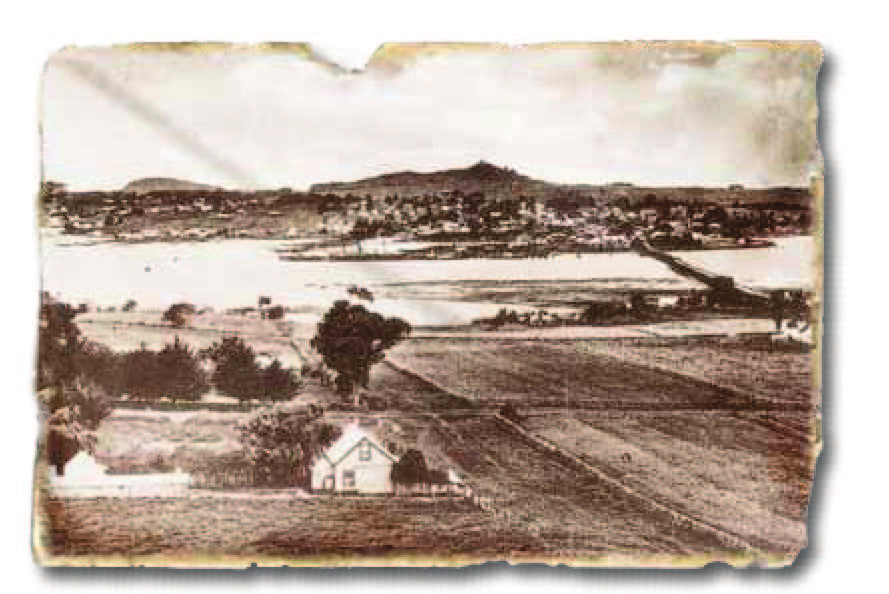

Frederick Willis
Born 27 January 1837 at Cambridge, third son of Professor Robert Willis, and educated at King William's College on the Isle of Man August 1850 - April 1854. Sent, together with his brother Alan, by his Father to New Zealand 'to earn a living the hard way'. In 1875-76 both he and Alan were on a 95 acre farm at Te Waiti.
The reports below imply that he lived for a while in Turnaga and Whangerei after his marriage, but then returned to Howick, and died in Auckland 11 May 1892.
A SINGULAR DEATH.
THE EFFECT of SWALLOWING a bone. A man named Frederick Willis died suddenly on Wednesday night, at the house of John Redid, bootmaker, Victoria-street, where he had been staying. Deceased, who had been farming at Turanga Creek, came to the city twelve months ago, with his wife and family, and since then has been hawking and selling greengroceries. He lived at Mr. Rodin's house from Monday last. Willis was in bad health since five years ago, when, drinking some soup one day, he swallowed a bone which lodged in his right lung, and was never extricated, eventually causing his death. An inquest was held atMr. Ryan's Empire Hotel, Nelson and Victoria Streets, yesterday. It was conducted by Dr. Philson, coroner, Mr. C. E. Carter being the foreman of the jury. Mrs. Willis, widow of deceased, deposed that last month her husband caught cold, but though he coughed greatly, he did not seek the aid of a medical man. On Wednesday he became so ill that witness had to remain constantly with him, and he died quietly at eleven o'clock that night. Witness believed that death was caused through his having swallowed the piece of bone five years ago. He had been ill ever since that time.
Thomas Long, who had been in business with deceased, deposed he was present when he swallowed the bone, and ever since that time he had suffered from coughing and distress of breathing, saying that the bone had gone into one of his lungs. It was not until about a year after this accident that it was mentioned to a medical man, Dr. Bewes, who then advised Willis to submit to an operation, but as the latter thought the remedy worse than the disease, he would not consent. Witness heard Willis say that he went to see Dr. Philson about another complaint, when the doctor told him that his lungs were damaged. This occurred some time after he saw Dr. Bewes.
The coroner said ho did not remember that Willis saw him, or mentioned to him that he had swallowed a bone, for in that case he would certainly have advised him to go to the Hospital. Dr. Roberton, who made a post mortem examination of the body of the deceased, deposed that ho had found the right lung utterly collapsed and solid, with numerous small abscesses containing purulent matter. In the right bronchus, buried in the substance of the lung, about two inches and a-half from the bifurcation of the trachea, he found a small, irregularly-shaped knob of bone. This was the cause of the diseased condition of the lung. Witness did not think that any operation, even at the first, would have been of any avail in extracting the bone. Death was due to chronic pulmonary disease, caused from this bone having become imbedded in the lung. The jury returned a verdict in accordance with the medical evidence. The bone, produced at the inquest, weighed about an eighth of an ounce. New Zealand Herald, 13 May 1892, p5
Married in 1877 in NZ to Susan Jane Bartlett. She was born in Howick, NZ, daughter of George Roche Bartlett and his wife Elizabeth, and sister of Alan Willis's wife Eliza Emma Bartlett. Her birth was registered in 1862, meaning she was might only have been 15 at the time of her marriage. As the reports below explain, she remarried in 1894 to Thomas Corlett, but didn't necessarily live with him and often went by the name 'Corbett'.
PECULIAR CHARGES OF FORGERY AND INCITING. THE ACCUSED COMMITTED FOR TRIAL. A special sitting of the Police Court was held in the Magistrate's Court-room, yesterday, before Mr. R. S. Bush, Stipendary Magistrate, to hear a charge of forgery preferred against Susan Jane Corbett, accused of forging the name of Fanny Corlett to a draft or money order, and John Grubb with inciting her to commit forgery. INCITING TO FORGERY. The case against John Grubb was taken first, Mr. McAlister prosecuting for the Crown, and Mr. Theo. Cooper appeared for the accused. The information charged the accused that on the 15th July he counselled and procured one Susan Jane Corlett to forge the name of Fanny Corbett to a certain document, to wit, a letter of credit for £30, drawn on the Union Bank of Australia. Mr. McAlister opened the case, and called Susan Jane Corlett. The statement of this witness was that on the 15th July she went to the Post Office and asked for any letters for her. A young man gave her one. She did not remember how it was addressed, except that it bore the name Corbett. She opened the letter, and then found that it was not for her. There was a draft in it. She did not read the letter. After this she had a drink, and went down the wharf, where she met Mr. Grubb and showed him the draft, who told her she could take it to the bank and get the money, but she was to sign the name "Fanny Corbett" on the back of it. Witness was known to be a married woman. She had known accused for about three years, but she did not stay at his house. She signed the draft at the bank, and received £30 in gold. When she came out of the bank the accused and Miss Lingard were waiting outside. They all went to the Thistle Hotel, and had drinks, and accused asked her how much she was going to give him out of it, and she gave him a sovereign. Miss Lingard burnt the letter, and accused advised her to put some of the money in the Savings Bank in her maiden name (Miss Bartlett). She lodged the money in the Auckland Savings Bank in the name of Susan Jane Bartlett. She last saw the accused in the waiting-room at the Police Court, when he asked her not to get him into trouble, and that he would do anything for her if she would say she never gave him any money, and that be would get her a lawyer; that it was no use for two to suffer for the one thing, that it would make it no easier for her. In cross-examination witness said she was always known as Corbett, not Corlett, and that was the name by which she was known to Mr. Grubb. In addition, she said Grubb knew Corbett was not her name, but her husband's letters were addressed to her in the name of Corbett, and she was known at the Post Office by that name, and that was how she got the letter. On the wharf he asked her to show him the draft, as he had been told by the girl she had it, and he told her how to get the money, but he did not tell her it would be necessary for some one to go to the bank with her. It was when she went to the bank that she signed the name Fanny Corbett on it. It was then about eleven o'clock, and when she left the bank she went to the Thistle Hotel with Miss Lingard and Mr. Grubb, and the letter was burnt there by Miss Lingard, and it was there witness gave Grubb a sovereign. She left the Thistle Hotel before dinner. She was not then properly sober, but she went to the bank. Grubb was not with her at the Waverley, but he was with her at the Thistle. She was not separated from her husband, and he corresponded with her, but Mr. Grubb did not know that. To His Worship: She paid £20 into the bank, but none of it was now there. Mabel Louisa Lingard, a young girl living with her parents, in Claremont-street, deposed that on the 15th of last month she was at Brister's in Elliott-street, and had breakfast there, after which she went to the post office with Mrs. Corlett, and saw Mrs Corlett get a letter which contained a draft. They went down the wharf and met Mr. Grubb, and Mrs. Corlett asked him what she could do with the cheque, and he told her, after looking at it, that he thought she could cash it all right, but not to say anything about it to anybody. The witness corroborated the evidence of Mrs. Corlett as to what took place at the Post Office, on the wharf, and in the hotels. In cross-examination the witness said Mrs. Corlett told her when they came out of the Post Office, and after the draft was cashed, and they had got to the Thistle Hotel, witnessed borrowed £2 from her in Grubb'a presence. Mr. William Arthur Knight, cashier of the Union Bank, gave evidence as to the draft being cashed. Mr. Cooper contended that there was no case to send for trial, and he was prepared to call evidence to prove that Mr. Grubb was entirely innocent, but if His Worship held, notwithstanding this, that he would send the accused for trial, it would be no use to call it. He pointed out that there was no evidence to show that accused knew her name was not Fanny Corbett. He further pointed out the contradictory nature of the evidence given by the witnesses, one of whom was, on her own confession, guilty of forgery, and the other a participant who, according to her own showing, was drinking that day in several hotels. He thought His Worship should take some responsibility. His Worship said so far as the case at present stood, he could only say there was a prima facie case. Mr. Cooper said he should call one witness, even if His Worship decided to commit, as he wished to have the evidence on the depositions. He called Miss Mattie Harley, who was barmaid at the Thistle Hotel on the 15th of July. She recollected the two women coming to the hotel between twelve and one o'clock on that day, and she served them with drinks in a room in Darby-street, just off the bar. When witness came back, the elder woman told her she had torn the letter up, and thrown it in the fire place, and asked did it matter. There was a man with them, but not the accused. He was not there with them at all that day. She was positive the man who was with them was not the accused. To Mr. McAlister: She had not spoken to anyone about the case. Detective Bailey made inquiries from her, but no one else. Mr. Cooper spoke to her, and took down her statement, but no one else besides those two spoke to her about the case. Grubb did not speak to her before Mr. Cooper came. She told Bailey she did not know anything whatever about the matter. It was Mr. Grubb who told her to come to Mr. Cooper's office, as he wanted to see her about the case against Mrs. Corlett, and he accompanied her to Mr. Cooper's office, and he told her she was accused. His Worship said, under the circumstances, he could not deal with the case. Accused was committed for trial, bail being allowed in two sureties of £50 each. THE CHARGE OF FORGERY. Susan Jane Corlett was then charged with forging the name of Fanny Corbett to a draft for money. Mr. McAlister prosecuted, and Mr. Purchas defended. The facts of the case have already been detailed in the previous case. Evidence was given by Mabel Louisa Lingard, Fanny Corbett, W. A. Knight, cashier of the Union Bank ; H. W. Watkins, clerk in the Auckland Savings Bank ; Detective Grace, and Constable Mclnness. The witness Fanny Corbett deposed that she was a single woman, at present living in Auckland. She had a brother in England, from whom she received £30 a quarter. She was expecting a remittance from the end of May last. Not receiving it, she inquired at the bank, and found that the draft had been cashed. Mr. Purchas said he intended to put the accused in the box, as he desired to have her evidence on the depositions. The accused being sworn, made a statement with regard to the forging of the document. She also stated that if it had not been for Grubb advising her to cash the draft she would have returned it to the post office. He had asked her for £5, but she had only given him £1. When he took the pound Grubb said that he would expect more later on. Witness was questioned by the Bench as to why she had not given this evidence in the case against Grubb. She replied that she did not think of it at the time. It was the first occasion she had been in Court, and she was somewhat confused. The accused was committed for trial, bail being allowed. New Zealand Herald, 7 August 1895, p3
LAW AND POLICE. - SUPREME COURT — CRIMINAL SITTINGS. - MONDAY. (Before His Honor Mr. Justice Conolly.) FORGERY. Susan Jane Corlett surrendered to her bail, and was charged that on the 15th of July, at Auckland, she forged an endorsement, "Fannie Corbett," to a document for payment of money; there was a second count, charging her with obtaining by false pretences from Arthur Knight the sum of £30,. She pleaded guilty, and His Honor intimated to Mr. Purchas, who appeared for the accused, that he should not deal with the case now. John Grubb was then charged that on the 15th July he committed forgery, by endorsing a note with the name, "Fanny Corbett, and on a second count he was charged with obtaining on false pretences from William Arthur Knight a sum of £30 in money. He pleaded not guilty, and Mr. Cooper appeared on his behalf. The accused himself exercised the right of challenge freely. Witnesses were ordered out of Court. Mr. Tole said the accused was charged with two kinds of offences — first with forging an endorsement to a money order, and second, with obtaining £30 by false pretences. The circumstances were these: The woman Susan Jane Corlett, a married woman, accompanied by Mabel Lingard, went to the General Post Office to look for a letter from her husband. She got a letter addressed Corbett, and on opening it she found a letter of credit addressed to Fanny Corbett. She herself always went by the name of Corbett. She and Lingard went under the Arcade and opened it and found it did not belong to her. They went down the wharf, met the defendant, and showed him the draft. He advised her to stick to it, sign her name as Fannie Corbett, and obtain the money. She and her friend went to the Union Bank, presented the draft, and she having signed the name "Fannie Corbett" on the back of the order was handed the money. They then went to a hotel where the woman Corlett gave £1 to accused and £2 to Mabel Lingard. The accused advised Corlett to lodge the money in the bank in her maiden name, Bartlett, and she did so. The letter was burnt in the Thistle Hotel. The question was, did accused know the draft was not for this woman, and if so, did he advise her to sign it and get it cashed? Susan Jane Corlett detailed the circumstances of receiving the letter and draft, and to showing it to accused. Mabel Lingard gave corroborative evidence. Fanny Corbett deposed that the endorsement was not hers, that it was a forgery. Detectives McMahon and Bailey deposed to the arrest of the accused on the 31st of July. Wm. Arthur Wright, clerk in the Union Bank, proved that Mrs. Corlett cashed the draft payable to Miss Corbett, and signed "Fanny Corbett" on the back of the draft presented and cashed at the Union Bank. Questioned by Mr. Cooper, he said that he had cashed the draft because, having cashed two previous ones, he thought it was in right hands. He did not know the prisoner till he saw him in Court. Mr. Cooper then opened the case for the defence, stating that there was some truth combined with a great deal of falsehood in the case for the prosecution. He called the accused, who detailed his acquaintance with the woman Corlett, and said when she showed him the draft and letter he did not read them, as he had not his spectacles, but he told her to go to the bank, get someone who knew her to identify her, and the cashier would tell her where to sign her name. He did not see the girl Lingard with her. He then left her, and went to attend to his duties at the Thames boat and the Corinna, which came into the Railway Wharf, and he did not see the women afterwards. Boswell Lee Bancroft, William McFadden, Richard Wood, Agnes Grubb, and Martha Harley gave evidence supporting the alibi. His Honor did not think it necessary to call on accused's counsel, and the jury, at six o'clock, returned a verdict of not guilty. The accused was discharged. The Court adjourned until ten o'clock next morning. New Zealand Herald, 10 September 1895, p3
LAW AND POLICE. - SUPREME COURT - CRIMINAL SITTINGS. TUESDAY. (Before His Honor Mr. Justice Conolly.) FORGERY. Susan Jane Corlett, who on the previous day had pleaded guilty to forging an endorsement on an order for the payment of money, was brought up for sentence. Mr. Purchas appeared for the accused, and addressed the Court, applying to have her admitted to probation under the First Offenders Probation Act, and called witnesses as to character. Thomas McGuiness, special constable, residing at Howick, said the prisoner's maiden name was Susan Jane Bartlett, and she was born in Howick, and left it about two years ago. After her marriage, she resided for a time in Whangarei, but she and her husband returned to Howick, and resided there for ten years. During that time he never knew anything wrong with her until this charge was brought against her. George Roche Bartlett, father of the prisoner, said his daughter lived in Howick most of the time during the last ten years, and left about 12 months ago, more or less, and he never heard a word against her character. She had been living with him lately, and he now had charge of her children. In reply to His Honor, the witness said the prisoner was married about 11 years ago or more, and her first husband was dead. She married the second husband about 12 months ago. He could not say why she was not now living with her husband, who was in Wellington. He was not prepared to say whether it may not be three years since she married her present husband. She was expecting a letter from her husband before she was arrested, and she used to come to town to see about it. She was staying with witness before she was arrested. Detective Grace, called by His Honor, said he had known prisoner for about two years by sight, and during the greater portion of that time she cohabited with a shoemaker in this city. Witness did not know her husband. She was never in the hands of the police, as she was quiet, but immoral. The woman Lingard who gave evidence was, he believed, a prostitute. His Honor said the report of the probation officer was unfavourable. Addressing the prisoner, he said she was quite aware she had committed a very bad offence, and she made it worse by attempting to throw the blame on another. The jury did not believe her story, and he (His Honor) coincided in their opinion. He did not believe her story or that of her associate, and he was quite certain she tried to throw the blame on a man who had nothing whatever to do with it. The report of the probation officer was similar to that of Detective Grace. If the money had been restored, or even a substantial portion of it, it would have made a difference in the sentence, but she had no doubt squandered it amongst her associates. The offence of forgery was a very serious one, and the sentence for it was one of the highest known to the law. He should not pass such a sentence on her, but he would mark his sense of her crime and the manner in which she attempted to get out of it. The sentence of the Court was that she be imprisoned and kept to hard labour for a term of two years. New Zealand Herald, 11 September 1895, Page 3
Issue two daughters and five sons:Elizabeth Eva Willis, born in 1878 and died 3 March 1879. Buried at All Saints, Howick.
Herbert Balicourt Willis, born about 1880 and died 27 April 1881. Buried at All Saints, Howick.
Willis.—On April 27, at his parents' residence, Puriri Hill, Howick, Auckland, New Zealand, Herbert Balicourt, only child of Frederic and Susan Jane Willis, aged 14 months.—Home papers and Northern Advocate please copy. New Zealand Herald, 23 May 1881, p6
Frederick Thomas Willis, born about 1882 and died 9 September 1893. Buried at Waikumete Cemetery, Auckland.
Ethel Grace Bartlett Willis, born about 1884
Robert Willis, born about 1887 and died about 1888.
Harold Edwin Willis, born about 1889. Married in 1909 to Lily Dorothea Bertha Schacht, and died in 1958.
WILLIS.—On November 16, at Vermont Street Hospital, from pleurisy, Lily Dorothea Bertha, the dearly loved wife of Harold E. Willis; aged 29 years 11 months. Deeply regretted. So loved, so mourned. Interred Sunday at Purewa. Inserted by her Sorrowing husband.
WILLIS.—On November 16, at Vermont Street Hospital, Lily Dorothea Bertha, the dearly-beloved wife of Harold Edwin Willis, of No. 1, Bath Street, Parnell, and sister of Mrs. A. G. Fisher, Netherton; aged 29 years and 11 months. Deeply regretted. Auckland Star, 18 November 1918, Page 8
WILL MR. HAROLD EDWIN WILLIS, late of Parnell, Auckland, or anyone knowing whereabouts, write his son Ron. c.o. 69 Howe Street, Newton, Auckland. New Zealand Herald, 24 February 1939, Page 1
George John Willis, born and died in 1892.